Showing posts with label team building. Show all posts

Monday, August 3, 2015

The Journey Home and Beyond


Our 2015 Iwi at Takahanga Marae in Kaikoura
Kia Ora.  Having been immersed in Kiwi and Maori culture for the past five weeks will now make the journey back to American culture another adventure.  Our students will take with them lasting memories of the challenges and opportunities of what not only New Zealand faces, but what the rest of the world faces as well.  Preserving biological diversity, conserving resources, and maintaining a balance between natural and human built environments are key to a sustainable future.  And, it will take all of us with our diverse backgrounds to come together in many different ways to help make lasting change for a bright future.

Dear students, we hope that what you have experienced with us in New Zealand will help shape the decisions you make for our future in exciting and positive ways.  We thank you for giving of yourselves openly with your hearts and minds so that our time together could be such a special learning opportunity for us all.  We have really enjoyed being with all of you, touring the wop-wops, and sharing a daily cuppa. Sweet As!

From the land of the long white cloud, safe and happy travels!  See you in the land of the flowers (La Florida).  With a Hongi and hug to each of you, Mark, Meryl, Jámm, and Tupelo
Last JC Penney pose at CHCH Airport this afternoon

Tuesday, July 28, 2015

White Flippers and Victorious Tititipounamu

Amazing how just a few degrees more and no wind can make one feel warm, even if it is only 53F degrees.  So we had that kind of morning and the sky was clear and the sea was calm when we arrived at our first destination for the day - Cave Rock (it was so clear, we could see all the way up the coast to the Kaikoura mountain range).
Cave Rock
Exploring tide pools
A tide pool
After checking out some of the anemones in the tide pools on the rocks, we headed over to Taylor's Mistake to hike the Godley Head track and look for endangered White-Flippered Penguins (and http://www.penguin.org.nz/resources/WFPT-Document-1.pdf).  The morning stayed perfect for our exploration of the small 200 meter-stretch of nesting boxes that are protected by a predator-proof fence (built in 2010), lay down a very steep ladder, and are at the base of the cliff and edge of the sea.  These boxes were put in place to both help protect these penguins that only nest in this one spot and off a nearby island, and to help with scientific study of this species.  To our delight and amazement we found two of these beautiful little penguins each in their own little box.
At the start of the hike in search of penguins (we will go almost all the way out to the land mass behind us before we go straight down to the rocks at the water's edge)
Predator proof fence from above
Heading down the ladder to the sea
Exploring the nesting boxes along the shore
A nest box
Amazing!
Hanging out by the nest boxes
Back up at the predator proof fence
After lunch, we explored The Tannery (a historic building from the 1800s that has been rehabilitated into shops) for a short time.
The Tannery
Then, the weather turned colder and cloudy and a little rainy, but we still showed up for our Cricket lesson/match.  Team Tititipounamu was victorious over Team Morepork, 43, 31, and we were all thankful when it was all over.  We did have a fun time learning the game, but think that 5 day matches might be agonizing.
Team Tititipounamu up at bat defending the wicket with Team Morepork out in the field
Victorious or not, happy to not be going on for four more days : )
Thanks for another fun day all! -Meryl

Sunday, July 12, 2015

Croesus Track Hike Part Deux In Pictures

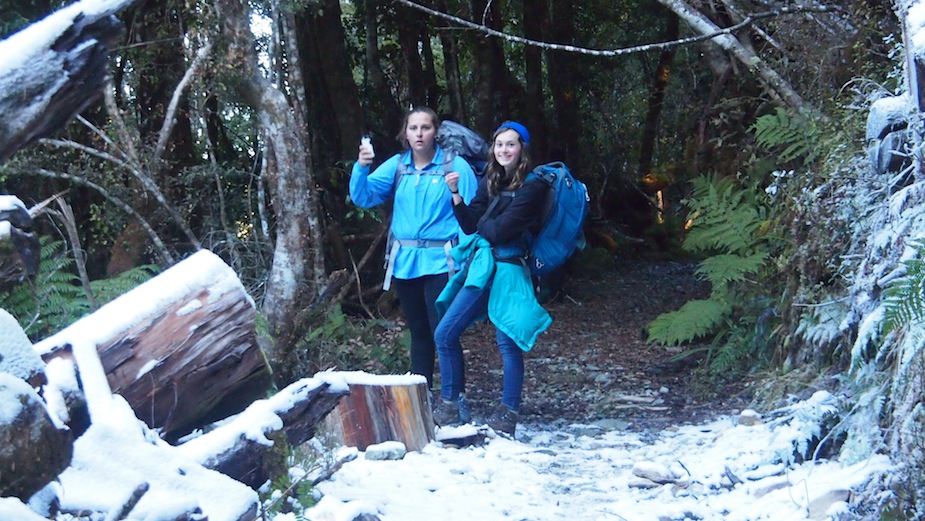
Wonderful couple days on the Creosus Track. Wonderful views, beautiful clear skies, cold feet, wow and wow, snow, and . . . . .  Pictures speak for themselves. Cheers Dr.H.
Lunch of snakes
Rare NZ robin
On the trail
Sunny day but chilly
Near the top
There it is - Cess Clark Hut
Dawn - 1
Dawn - 2
Dawn - 3
Dawn - 4
Breakfast of champions
Southern aAps
On the track!
Cess Clark Hut
Dr, Colin Meurk discussing alpine plants
Snow!
You can see Mt Cook (Aoraki)
On the ridge
Just a view
Crab!
Lunch!
Bye to Cess Clark
Swing bridge
The after photo
One last robin shot


Thursday, July 9, 2015

New Brighton Beach and Travis Wetland

Today started with a lecture from Dr. Colin Meurk concerning ecosystem restoration theory, principles, and practice. Dr. Meurk discussed the proper steps to enhancing biodiversity by repairing the existing ecosystem and establishing connectivity between people, culture, and nature.
Dr. Meurk explaining restoration processes.
Afterwards, we drove to New Brighton beach with Dr. Meurk who took us on a tour of the sand dunes, pointing out native plants like sedge grass, daisy shrub, and cabbage trees, the oldest established vegetation being from 1990. It was showering and cold, but the landscape was totally worth braving a little rain.
New Brighton Beach
Next we took a trip over to Travis Wetland, originally intending to be a housing development. Instead, it has become a restored wetland, protected by the Christchurch City Council in 1997. It is vital to conserve lowland freshwater wetlands in New Zealand, which are scarce throughout the country. The wetland features a diversity of native birds, insects, fish, and plants. It also provides excellent opportunities for wildlife viewing and research on ecology and habitat restoration.

Rainbow over the wetland!
Taking a stroll with Dr. Meurk

Afterwards, we went back to New Brighton and frolicked - yes, frolicked - on the beach for a bit, and played on the playground across the street like children. We braved the zipline, and then stopped for a tea break at the Naked Baker.
Christina letting out her inner wild woman. 
Warm drinks at the risqué Naked Baker.
Despite rain showers on and off all day, it was another beautiful New Zealand day, providing an excellent background for the most ridiculous jumping beach picture you will ever see.
We tried.

~Bridget

Thursday, July 2, 2015

Crossing the River of Hot Chocolate and Key Conservation Principles and Pavlova

Ok - so how does the river of hot chocolate relate to key conservation principles and Pavlova? Well, maybe they do (or do not!) - read on...

The class met on a wet tennis court in the morning - with fairly clear skies and relatively warm weather - ready to take on Dr.H's puzzles and team building exercises. After quickly solving "speed ball", the students got a bit tied up in knots with the "Gordian Knot." Here, they all got up close and personal in untangling the knot - and solved this fairly quickly (with no twisted arms!).
One way to keep warm - Gordian Knot style!
Next up was crossing the river of hot chocolate. This entails getting 10 people across a "river" on floating marshmallows (cardboard pieces). The class was quite adept at handling the marshmallows and ferrying everybody from one side to the other. Dr. H was quite impressed with the cooperation demonstrated during this exercise.
Crossing the River of Chocolate!
The class next were presented with a puzzle called crosstown traffic. The idea was to figure out how to move one team to the other side through a sequence of moves. After trying several methods, the class moved through this exercise after several tries and solved the puzzle. Jet lagged and all - well done!
Cross town traffic
After the morning exercises, some piled into the "gatorwaka" (the 12 seater minibus), and we went to The Warehouse, Postie Plus, and the bank to get some clothes, other supplies, and kiwi dollars. On the way, we had some good views of the alps and sheep in nearby paddocks.

The afternoon was orientation and a lecture/introduction about key conservation principles and biodiversity issues in New Zealand. As presented, in the Canterbury plains, very little native lowland vegetation remains (less than 5%). Agriculture and urban areas now dominate the plains and key practices to conserve biodiversity include: 1) conserving remnant habitat, 2) restoration, and 3) minimize impacts stemming from urban and rural areas. Even small patches of remnant vegetation is important. Partnering with landowners (big and small), there is an effort to create green dots throughout the plains and create stepping stones from the coast to the alps (see Te Ara Kakariki). These patches of habitat provide ways for both plants and animals to move across the landscape (e.g., birds eating fruits and depositing seeds in new areas).
Students diligently taking notes
In addition to very little native vegetation left, a huge effort goes into controlling introduced animals such as rats, possums, rabbits, and deer. Terrestrial mammals were not historically present in New Zealand (save a few bats) so most of the flora and fauna have no defenses against browsing mammals and predators. These critters have huge impacts on native flora and fauna. The composition of forests change dramatically when possums are present.  Some plant species can go locally extinct due to possums.
Pavlova
In the evening, students came over to Dr.H and Meryl's flat to experience "kiwiana" - Pavlova and L&P (a soft drink "World Famous in New Zealand").  We also watched an episode of Flight of the Conchords and played Heads Up before looking at the Southern Cross in the night sky and heading back to get some sleep.

Signing off Dr. H and Meryl